How to Prepare for the Hungarian Citizenship Interview: What You Actually Need to Be Able to Do
If you are preparing for the Hungarian citizenship interview as part of the simplified naturalization procedure, you may already have searched online for Hungarian citizenship interview questions.
You may even have a long list of questions and prepared answers.
That can certainly help. But after working with students preparing for their Hungarian citizenship interviews, I have noticed something important:
Knowing the questions is only one part of being able to handle the interview in Hungarian.
Your Hungarian doesn't have to be perfect, either.
During the interview, you need to be able to communicate with the Hungarian you already have – even when you are nervous, you do not understand a question immediately, or you cannot remember the exact word you wanted to use.
So what should you actually prepare for?
What do people expect from the Hungarian citizenship interview?
Many learners imagine the interview as a predictable question-and-answer situation.
The consul asks:
Where do you live?
You answer.
Are you married?
You answer.
What do you do for work?
You answer.
And if you learn enough possible questions and prepare an answer for each one, you will be ready.
Unfortunately, real communication does not work like that.
The person interviewing you can phrase a familiar question differently. They can ask a follow-up question. They can react to something you have just said. They may ask you to explain something in more detail.
And the Hungarian communication may begin before the formal interview itself.
You might be asked why you are there, what time your appointment is, or for certain documents when you arrive.
This is why preparing for the Hungarian citizenship interview should involve much more than memorizing a list of questions.
Communication skills matter as much as the Hungarian you know
One of the biggest misconceptions I see is that people think they will be ready for their citizenship interview when they finally "know enough Hungarian."
But what does enough mean?
Even advanced speakers sometimes forget words. Native speakers misunderstand each other. We ask people to repeat themselves. We explain a word in a different way when the exact expression does not come to mind.
Experienced speakers simply have ways of keeping the conversation going when something goes wrong.
This is something Hungarian learners can practise too.
For example, you can learn how to:
ask someone to repeat or rephrase a question;
tell them that you did not understand something;
buy yourself a few seconds to think;
describe something when you cannot remember a word;
give more than a one-word answer;
steer the conversation towards topics you are comfortable talking about;
recover when you freeze or lose your train of thought.
All of these are natural communication skills in Hungarian, and during a citizenship interview, they can be extremely valuable.
Don't just answer the question – have a conversation
Consider a very simple interview question:
Van gyereke?
Do you have children?
You could answer:
Igen.
Yes.
The answer is correct. But the conversation immediately stops.
Now compare it with:
Igen, van két gyerekem. Egy fiam és egy lányom. Mindketten iskolába járnak.
Yes, I have two children. I have a son and a daughter. They both go to school.
You have answered exactly the same question.
At the same time, you have demonstrated that you can communicate in Hungarian.
And you have given the interviewer several natural possibilities for continuing the conversation.
This does not mean giving a five-minute speech every time somebody asks you a simple question. Often, one or two additional sentences are enough.
Why memorizing Hungarian citizenship interview answers isn't enough
Prepared answers can be very useful.
The problem begins when you can only give the answer in exactly the form in which you memorized it.
Imagine that you prepared an answer to:
Hol dolgozik?
Where do you work?
But instead, you hear a slightly different question about your job. (E.g.: Mivel foglalkozik?)
If you have learned an entire answer as one block of text without developing your listening and speaking skills, a small change in wording can suddenly make a familiar topic feel unfamiliar.
This is why interview preparation should include both listening and spontaneous speaking.
You want to recognize different ways of asking similar questions. And you want to be able to build an answer from the Hungarian you know instead of searching your memory for a memorized paragraph.
How can you actually practise for the Hungarian citizenship interview?
Once you know which communication strategies can help you, the next step is to make them familiar enough that you can actually use them when you are nervous.
That happens through practice. And the practice should be as close as possible to the situations you are preparing for.
For example:
If you sometimes don't understand a question, practise asking for clarification instead of stopping the conversation.
When your answers tend to be very short, take a simple answer and practise adding one or two natural sentences.
Listen to the same type of interview question phrased in several different ways. This helps you recognize the meaning rather than relying on one memorized version.
Talk about the things you are actually likely to discuss: your family, your work, where you live, your daily life and your connection to Hungary.
With repetition, these responses start to feel familiar. You have already asked someone to repeat a question. You have already forgotten a word and found another way to explain it. You have already answered questions about your own life many times.
That familiarity can make a big difference when you are sitting in the actual interview.
And practise asking questions too.
This may sound surprising, because during the interview you are mainly expecting to answer questions. But learning to formulate typical interview questions yourself helps you become familiar with their structure and vocabulary.
When you later hear similar questions during the real interview, they are much easier to recognize.
Practise listening at different levels
Listening comprehension deserves special attention.
When you study from written lists of citizenship interview questions, you can read them at your own pace. During the actual interview, you cannot.
You have to understand spoken Hungarian in real time.
That is why practising with audio is so important.
It is also useful to work with material at different levels. Something that initially feels difficult can become manageable after repeated exposure and practice.
The goal is to become increasingly comfortable processing spoken Hungarian and responding without panicking when you don't catch everything immediately.
Practise the whole experience, not only the interview questions
There is another part of citizenship interview preparation that is easy to overlook.
Your experience does not necessarily begin with the first official interview question.
You arrive. You may need to speak to someone at the reception desk. You may be asked about your appointment or why you are there. There may be administrative steps. You will need to follow instructions.
This means it makes sense to practise the whole communication experience, not only a collection of interview questions.
The more elements of the situation you have already practised in a safe environment, the fewer things will feel completely new on the actual day.
And that matters when you are already nervous.
This is exactly why I created the Hungarian Citizenship Interview Program
After helping many students prepare for their citizenship interviews, I wanted to create something that went beyond giving students another list of questions.
So I created my 16-week Hungarian Citizenship Interview Program for people preparing for the simplified naturalization procedure who already speak at least some Hungarian and want to become more confident communicating during their interview.
We practise every week in live small-group sessions.
The purpose is to help you become better at actually using your Hungarian in an interview situation, rather than relying mainly on memorized answers.
What will we work on?
The program includes:
230+ typical citizenship interview questions – so you know what kinds of topics and questions you may encounter.
Your CV, family tree and personal story – so you can confidently talk about information that is directly relevant to you.
Listening exercises at A1, A2 and B1 levels – we work with all three levels so you gradually become more comfortable understanding spoken Hungarian.
Practising asking questions to each other – so you become familiar with the structure and vocabulary of common questions and recognize them more easily when someone asks you.
Communication strategies and rescue phrases – so you know what to do if you do not understand something, forget a word, freeze or need a little time to think.
Paraphrasing and clarification strategies – so one missing word does not have to stop the entire conversation.
Realistic interview simulations – so your actual citizenship interview is not the first time you experience the situation.
Listening and speaking practice – so you are actively using the Hungarian you have been learning.
Preparation for the wider interview experience – including communication that may happen when you arrive, not only the formal interview questions.
Audio, texts and questions for independent practice – so you can continue practising before and after our live sessions.
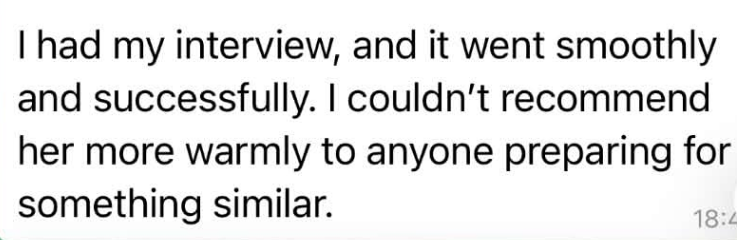
What have previous students said?
Of course, I can tell you what I believe is useful.
But what matters much more is what happens when students actually go to their interviews.
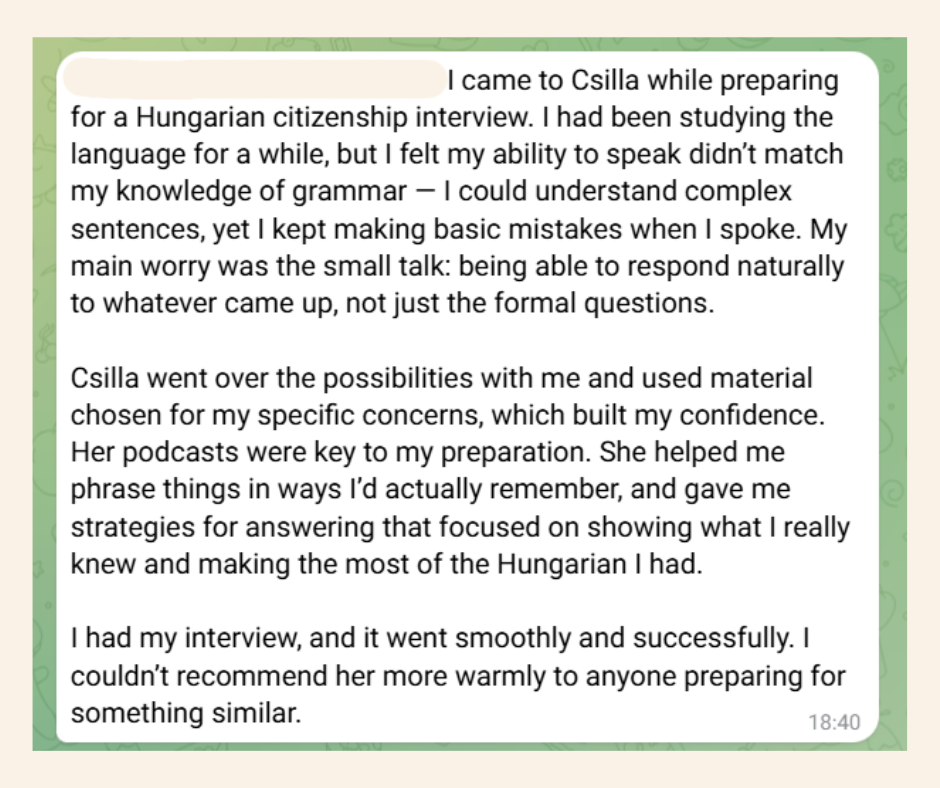
This is some of the feedback I have received from people I have helped prepare:
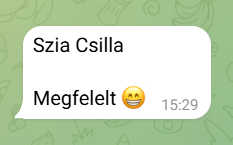

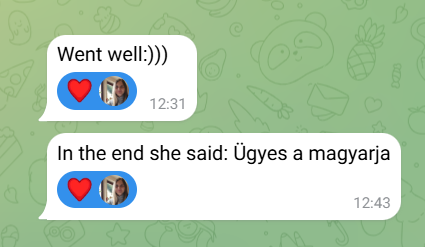
One of my favourite messages came from a participant who contacted me immediately after her interview. She told me that the interview had gone really well, that the atmosphere had been pleasant – and that at the end, they even complimented her Hungarian.
That is exactly what I want my students to experience: walking into the interview with the confidence that they know how to communicate, even when the conversation does not follow a perfectly predictable script.
Is the Hungarian Citizenship Interview Program right for you?
The program is designed for people who are preparing for the Hungarian simplified naturalization procedure and already have some basic Hungarian.
Your Hungarian can still be at a relatively basic level.
This program assumes, however, that you already have some foundations in Hungarian. You should be able to understand some simple questions, create basic sentences and communicate at least a little in Hungarian.
Students with higher levels of Hungarian can also benefit, because communicating confidently under pressure is a separate skill from simply knowing vocabulary and grammar.
How to apply
I keep the groups small because the program involves live speaking practice, individual answers and interaction.
For this reason, joining starts with a short, free application.
The application takes approximately two minutes and there is no payment required at this stage.
I personally review each application to see whether the program is suitable for your current Hungarian level and goals.
If I think the program is a good fit for you, I will invite you to join and send you the next steps.
You don't have to wait until your Hungarian is perfect
Waiting until you know every possible word, every grammatical structure and every possible answer can easily turn interview preparation into an endless process.
A much more practical goal is to learn to communicate confidently with the Hungarian you have – and keep improving it through practice.
That includes knowing what to do when a conversation is going smoothly, as well as having strategies for the moments when you do not understand something immediately.
By the time you sit down for your interview, you want these situations to feel familiar. You have practised answering, asking for clarification, paraphrasing, listening and continuing a conversation.
The goal is to be able to have a conversation in Hungarian.